Mallorca · Menorca · Ibiza · Formentera · 2026–27 edition
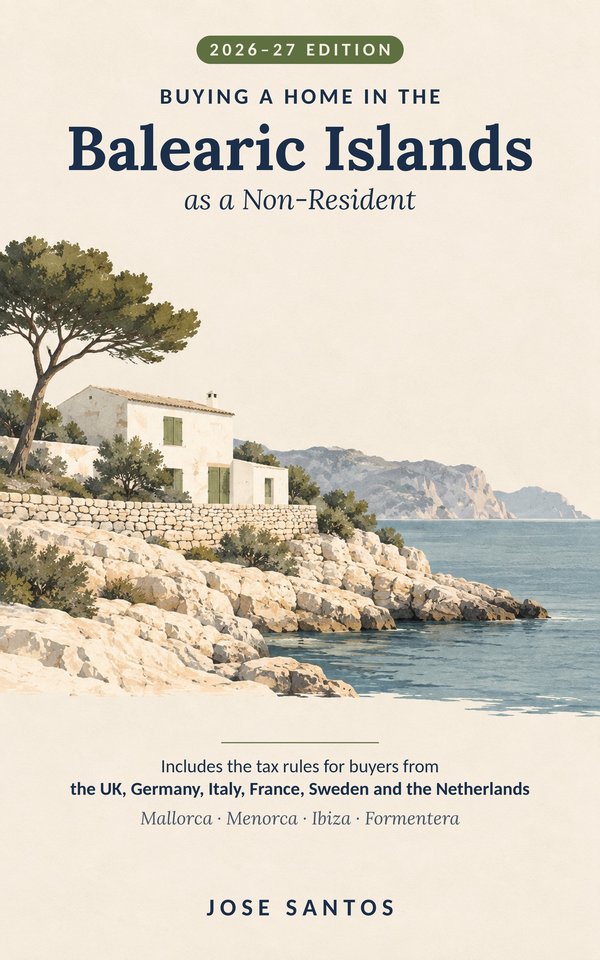
Buying a Home in the Balearic Islands as a Non-Resident
A practical guide for buyers who live outside Spain. It follows a home through its life, from buying and owning to letting, selling and leaving it to your children, and answers the questions buyers from abroad ask at each step.
- Rules in force in 2026–27
- Worked examples with real figures
- How six home countries tax the same house
- Paperback and Kindle
Start here
Buying
What it costs, what to check and the order to do it in.
Owning and letting
The tax you pay every year, and the rules for holiday lets.
Selling
Tax on the gain, and the 3% your buyer keeps back.
Inheriting
What your children or other heirs would pay, in Spain and at home.
It answers questions such as
- Can I buy as a foreigner?And what you need before you start looking: NIE, bank account, power of attorney.
- What does buying cost on top of the price?Transfer tax or VAT, stamp duty, notary, Land Registry, and why the Catastro reference value matters.
- How does the process work, from offer to keys?Reservation, deposit, private contract and the signing at the notary.
- What should my lawyer check before I sign?Especially for a country house on rural land.
- What work can I do on the house?Which licences you need, and what the work costs in tax.
- Can I let the home to holidaymakers?Tourist licences and places island by island, and how rent is taxed.
- What do I pay each year as a non-resident?Non-resident income tax, IBI and wealth tax.
- What happens when I sell?Tax on the gain and how to recover the 3% your buyer withholds.
- What if I leave it to my children?Balearic inheritance and gift tax, wills, and giving the house now or later.
- How does my own country tax the home?Germany, the UK, Italy, France, Sweden and the Netherlands.
Inside the book
- 1. Before You StartNIE, bank account, power of attorney, and whether you need a tax representative.
- 2. Choosing Your Island and AreaHow Mallorca, Menorca, Ibiza and Formentera differ for a buyer.
- 3. The Buying Process, Step by StepFrom the offer to the notary, choosing your lawyer, whose name to buy in, off-plan purchases.
- 4. The Legal ChecksLand Registry, licences, rural land, utilities and debts that come with the house.
- 5. Renovating and Building WorkWhich work needs which licence, and what it costs in tax.
- 6. What Buying Really CostsTransfer tax, VAT, stamp duty, the reference value and fees.
- 7. Financing Your PurchaseMortgages for non-residents and what banks lend.
- 8. The Yearly Cost of OwningNon-resident income tax, IBI, wealth tax and the forms to file.
- 9. Renting Out Your HomeTourist licences and places, guest registration and tax on rent.
- 10. Selling Your HomeTax on the gain, the 3% withholding and the municipal plusvalía.
- 11. Leaving Your Home to Your ChildrenBalearic inheritance and gift tax, wills and the EU rules.
- 12. Making the Move: Becoming ResidentWhat changes, in tax and paperwork, if you move to the islands.
- 13. Country Annex: Your Taxes at HomeGermany, the UK, Italy, France, Sweden and the Netherlands.
- 14. Four Owners, Start to FinishFour case studies from the first offer to who inherits.
Plus: scenarios compared side by side, a directory of official sources, and a glossary of Spanish terms.
Try the numbers on your own home
The free calculator that goes with the book estimates the Spanish taxes on buying, owning, letting, selling and inheriting, plus what your own country may add. It runs in your browser and needs no sign-up.
The book's example: a €750,000 resale home
Owner resident in the Netherlands, rules in force in September 2026.
Keep your figures up to date
Get the calculator as a spreadsheet and a short email when Spanish or Balearic rules change. No more than a few emails a year.
Common questions
How much does it cost to buy a home in the Balearics as a non-resident?
Budget around 10% of the price on top of the price for a resale home, almost all of it tax. Transfer tax is banded: 8% up to €400,000, 9% to €600,000, 10% to €1,000,000, 12% to €2,000,000 and 13% above, charged on the higher of the price and the Catastro reference value. In the book's worked example, a €750,000 resale villa costs €65,918 in tax and notary and Land Registry fees, before your lawyer's fee of around 1% plus VAT.
Can I let my Balearic home to tourists?
Only if the home qualifies, and many do not. At the time of writing, no new tourist licences are granted for flats in apartment buildings anywhere in the islands (since April 2025), and Palma accepts no new holiday lets in homes. A house can be let if it is in an area zoned for it, has been a private residence for at least five years, and holds a licence plus tourist places, one per guest. The safest route is a house that already holds a licence. From 1 December 2026, stays of 30 nights or fewer also carry 10% VAT, if the October 2026 housing decree is confirmed.
Do I pay tax every year if I don't let the home?
Yes. Spain taxes non-resident owners on notional income even if the home is never let: 1.1% of the cadastral value (2% if it has not been revised in the last ten years), taxed at 19% if you live in the EU, Iceland, Norway or Liechtenstein and 24% anywhere else, including the UK. On a cadastral value of €300,000 that is €627 or €792 a year, filed on form 210. The town hall's IBI and waste charge come on top. From 2027, a housing decree in force since 8 October 2026 would replace both rates with a banded scale from 1.1% to 3% on the owner's total cadastral value, if parliament confirms it by early November 2026.
How much inheritance tax will my children pay on a Balearic home?
Usually none in Spain. Under Balearic rules, children, spouses and parents get a 100% relief, so a €750,000 villa can pass to a son or daughter with no Spanish inheritance tax. For deaths from 25 July 2025, the relief also applies to heirs who live abroad. The return (forms 650 and 660) must still be filed within six months, and the declared value must not exceed the reference value by more than 20%. Your own country may still tax the home.
Do non-EU buyers need a military permit in the Balearics?
Yes, to buy rural land. Buyers who are not citizens of an EU country, including British, Swiss and Norwegian buyers, need prior authorisation from Spain's Ministry of Defence to buy rural land anywhere in the islands. It is not normally required for homes on urban land. Companies controlled by non-EU owners are covered too, and without the permit the purchase cannot be authorised or registered. Apply once you have a reservation and make the contract conditional on the permit.
What should my lawyer check on a country house (finca)?
First, whether the plot is protected or ordinary rural land. On protected rural land, unlicensed work can be ordered demolished at any time, however old; on ordinary rural land an eight-year limit applies. Your lawyer should check the date and licence of every structure, not just the house, and whether legalisation is possible: the windows close in 2028 on Mallorca, Menorca and Ibiza. Check the water supply, septic tank and a legal electricity connection too.
How long does buying a home in the Balearics take?
Several weeks to a few months between offer and completion is common. The timing depends mostly on the legal checks, the mortgage and, for non-EU buyers of rural land, the military permit. Start the paperwork early: an NIE applied for at a consulate can take from a few weeks to a couple of months, so apply as soon as you are serious about buying. After completion, transfer tax must be paid within one month of the deed.
Can I get a Spanish mortgage as a non-resident?
Yes, but banks lend non-residents less than residents: typically 60% to 70% of the value if you live in the EU and 50% to 60% if you live outside it, applied to the lower of the price and the bank's valuation. Terms are usually 20 to 25 years. Once purchase costs are added, plan to fund 40% to 50% of the price yourself from the EU, or 50% to 60% from outside it. The bank pays most set-up costs, but you pay the valuation.
Will I pay wealth tax on a Balearic home?
Only if your Spanish assets are large. As a non-resident you are taxed only on assets in Spain, less debts on them, and you can opt for Balearic rules, which give a €3,000,000 tax-free allowance instead of the national €700,000. The catch is that the Balearic allowance applies only if you file form 714 and choose Balearic rules, even when the result is zero. The solidarity tax applies above €3.7 million net, less any wealth tax paid.
Short answers based on the 2026–27 edition. More in the glossary, the regional comparison and the list of rule changes.
About the book
How up to date is it?
The 2026–27 edition reflects the rules in force in September 2026, including the 2025 change that extended the Balearic inheritance tax relief for children to non-residents. Spanish and Balearic rules change often, so each edition is updated, and the book flags the points most likely to change.
I don't live in one of the six countries in the annex. Is it still useful?
Yes. Everything except the country annex applies to any non-resident buyer. The annex covers Germany, the United Kingdom, Italy, France, Sweden and the Netherlands; for other countries, the book tells you what to ask a local adviser.
Is it legal or tax advice?
No. It is general information to help you understand the process and the numbers, and to ask the right questions. Before you sign anything, take advice from an independent Spanish lawyer and, where relevant, a tax adviser in your own country.
Paperback or Kindle?
Both have the same content. The paperback is 6 × 9 inches; the Kindle edition works on any Kindle device or the free Kindle app.
Do I need the book to use the calculator?
No. The calculator is free and needs no sign-up. The book explains where each figure comes from, the risks behind them and the deadlines.