Dénia · Jávea · Calpe · Benidorm · Alicante · Torrevieja · 2026–27 edition
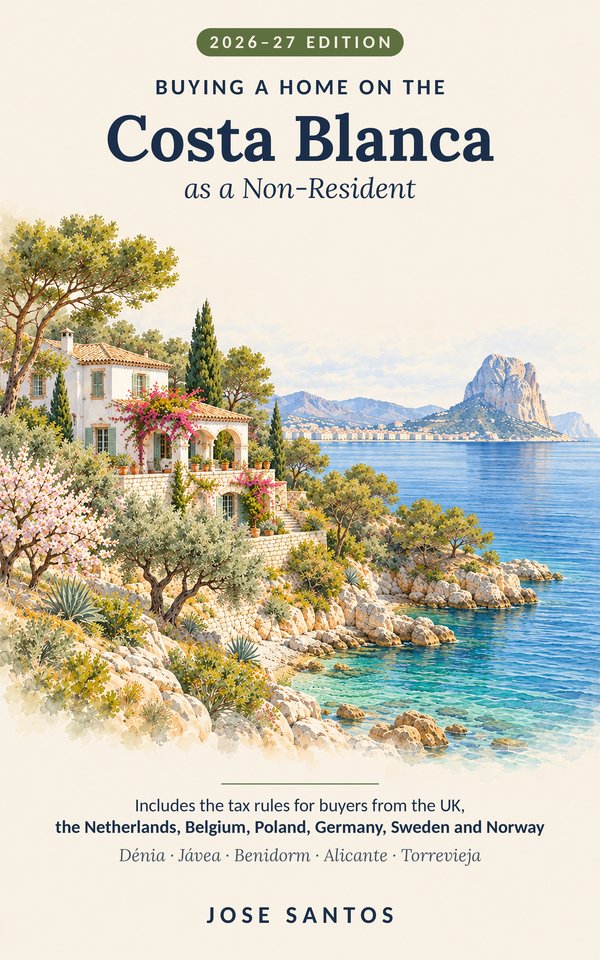
Buying a Home on the Costa Blanca as a Non-Resident
A practical guide for buyers who live outside Spain. It follows a home through its life, from buying and owning to letting, selling and leaving it to your children, and answers the questions buyers from abroad ask at each step.
- Rules in force in 2026–27
- Worked examples with real figures
- How seven home countries tax the same house
- Paperback and Kindle
Start here
Buying
What it costs, what to check and the order to do it in.
Owning and letting
The tax you pay every year, and the rules for holiday lets.
Selling
Tax on the gain, and the 3% your buyer keeps back.
Inheriting
What your children or other heirs would pay, in Spain and at home.
It answers questions such as
- Can I buy as a foreigner?And what you need before you start looking: NIE, bank account, power of attorney.
- What does buying cost on top of the price?The 9% transfer tax and the €1 million step, VAT and stamp duty on new builds, fees and the Catastro reference value.
- How does the process work, from offer to keys?Reservation, deposit, private contract, the notary, and the military permit some non-EU buyers need in the south.
- What should my lawyer check before I sign?Unlicensed building on rural land, development charges, developments never handed over, flood risk.
- What work can I do on the house?Which licences or declarations you need, and what the work costs in tax.
- Can I let the home to holidaymakers?The Valencian registration, the town hall report, the towns that have stopped new lets, and how rent is taxed.
- What do I pay each year as a non-resident?Non-resident income tax, IBI and wealth tax.
- What happens when I sell?Tax on the gain and how to recover the 3% your buyer withholds.
- What if I leave it to my children?The Valencian 99% reduction, the new reliefs for brothers, sisters, nephews and nieces, and wills.
- How does my own country tax the home?The UK, the Netherlands, Belgium, Poland, Germany, Sweden and Norway.
Inside the book
- 1. Before You StartNIE, bank account, power of attorney, and whether you need a tax representative.
- 2. Choosing Your AreaThe coast from Dénia to Pilar de la Horadada, Alicante city and the countryside inland.
- 3. The Buying Process, Step by StepFrom the offer to the notary, the military permit in the south, whose name to buy in, off-plan purchases.
- 4. The Legal ChecksLand Registry, licences, rural land, development charges, flood maps and debts that come with the house.
- 5. Renovating and Building WorkWhich work needs which licence, and what it costs in tax.
- 6. What Buying Really CostsTransfer tax, VAT, stamp duty, the reference value and fees.
- 7. Financing Your PurchaseMortgages for non-residents and what banks lend.
- 8. The Yearly Cost of OwningNon-resident income tax, IBI, wealth tax and the forms to file.
- 9. Renting Out Your HomeRegistration, town restrictions, guest registration and tax on rent.
- 10. Selling Your HomeTax on the gain, the 3% withholding and the municipal plusvalía.
- 11. Leaving Your Home to Your ChildrenValencian inheritance and gift tax, wills and the EU rules.
- 12. Making the Move: Becoming ResidentWhat changes, in tax and paperwork, if you move to Spain.
- 13. Country Annex: Your Taxes at HomeThe UK, the Netherlands, Belgium, Poland, Germany, Sweden and Norway.
- 14. Four Owners, Start to FinishFour case studies from the first offer to who inherits.
Plus: scenarios compared side by side, a directory of official sources, and a glossary of Spanish terms.
Try the numbers on your own home
The free calculator that goes with the book estimates the Spanish taxes on buying, owning, letting, selling and inheriting, plus what your own country may add. It runs in your browser and needs no sign-up.
The book's example: a €450,000 resale villa
Owner resident in the Netherlands, rules in force in October 2026.
Keep your figures up to date
Get the calculator as a spreadsheet and a short email when Spanish or Valencian rules change. No more than a few emails a year.
Common questions
How much does it cost to buy a home on the Costa Blanca as a non-resident?
Budget around 10% of the price for a resale home, or 12% to 13% for a new build. Transfer tax is 9% of the whole value up to €1,000,000 (10% before 1 June 2026) and 11% of the whole value above that, charged on the higher of the price and the Catastro reference value. In the book's worked example, a €450,000 resale villa costs €41,207 in tax and notary and Land Registry fees, plus a lawyer's fee of around 1% plus VAT.
Can I let my Costa Blanca home to tourists?
Possibly, depending on the town and the building. At the time of writing, every holiday let (stays of ten days or less) needs a favourable town hall report and a Valencian registration valid for five years. Since 3 April 2025 a new let in a flat also needs the approval of three-fifths of the owners. Alicante city, Dénia, Jávea and several other towns have suspended or capped new lets, while Torrevieja and Elche still accept them. Check the exact address. From 1 December 2026, stays of 30 nights or fewer also carry 10% VAT, if the October 2026 housing decree is confirmed.
Do I pay tax every year if I don't let the home?
Yes. Non-resident owners pay tax on notional income even if the home is never let: 2% of the cadastral value in most Costa Blanca towns, including Dénia, Jávea, Benidorm, Orihuela and Torrevieja, whose values were last revised long ago (1.1% where a general revaluation took effect in the last ten years). It is taxed at 19% for residents of the EU, Iceland, Norway or Liechtenstein and 24% for everyone else, including the UK. For the book's villa, with a cadastral value of €150,000, that is €570 or €720 a year, on form 210. From 2027, a housing decree in force since 8 October 2026 would replace both rates with a banded scale from 1.1% to 3% on the owner's total cadastral value, if parliament confirms it by early November 2026.
How much inheritance tax will my children pay on a Costa Blanca home?
Very little in Spain. Under Valencian rules, children, grandchildren, spouses and parents get a €100,000 allowance (more for children under 21) and a 99% reduction, whether they live in Spain or abroad. A €450,000 villa left to one child costs about €686 in Spanish inheritance tax, or about €167 each for two children. File within six months: the 99% reduction can be lost on a late return filed after the tax agency has written to the heirs.
Do non-EU buyers need a military permit on the Costa Blanca?
Only for rural land in four southern municipalities. Buyers who are not EU citizens, including British, Norwegian and Swiss buyers, need Ministry of Defence authorisation for rural land in Torrevieja, Orihuela (including Orihuela Costa), Pilar de la Horadada and San Miguel de Salinas. Since July 2021 it is not required for homes on urban land, which covers almost every flat and villa in a development, although this rests on an internal Ministry instruction, so ask your lawyer to confirm it for the plot. Elsewhere on the Costa Blanca no permit is needed. It can take several months.
What should my lawyer check on a country house?
Start with the land classification and the date and licence of every structure. On ordinary rural land there has been no time limit for action against unlicensed work since February 2019, and on protected land there is none, although work whose earlier time limit had already run out remains safe, so ask your lawyer to check the dates. Many homes completed before 20 August 2014 can be regularised, at a cost. Also check the water source, an authorised septic tank, a legal electricity supply, the flood maps (PATRICOVA and SNCZI) and, where relevant, the military permit.
How long does buying a home on the Costa Blanca take?
Several weeks to a few months between offer and completion is common. The timing depends mostly on the legal checks, the mortgage and, for some non-EU buyers in the south, a military permit, which can take several months. Get your NIE early: consulates take from a few weeks to a couple of months, and appointments in the province of Alicante can be hard to get. After completion, transfer tax is due within one month of the deed.
Can I get a Spanish mortgage as a non-resident?
Yes, but expect to borrow less than a resident. Banks typically lend 60% to 70% of the value if you live in the EU and 50% to 60% if you live outside it, on the lower of the price and the bank's valuation. Plan to fund 40% to 50% of the price yourself from the EU, or 50% to 60% from outside it. Terms are usually 20 to 25 years, but many banks want the loan repaid by about age 75.
Will I pay wealth tax on a Costa Blanca home?
Only on large Spanish assets. As a non-resident you are taxed only on assets in Spain, and opting for Valencian rules gives a €1,000,000 allowance instead of the national €700,000, but only if you file form 714, even when the result is zero. A July 2026 law raises the allowance to €2,000,000 from the 2026 tax year, but at the time of writing it is not settled whether non-residents can use it, so plan on €1,000,000.
Short answers based on the 2026–27 edition. More in the glossary, the regional comparison and the list of rule changes.
About the book
How up to date is it?
The 2026–27 edition reflects the rules in force in October 2026, including the Valencian transfer tax cut to 9% from June 2026, the new inheritance tax reliefs for brothers, sisters, nephews and nieces, and the latest town rules on holiday lets. Spanish and Valencian rules change often, so each edition is updated, and the book flags the points most likely to change.
I don't live in one of the seven countries in the annex. Is it still useful?
Yes. Everything except the country annex applies to any non-resident buyer. The annex covers the United Kingdom, the Netherlands, Belgium, Poland, Germany, Sweden and Norway; for other countries, the book tells you what to ask a local adviser.
Does it cover the whole Costa Blanca?
Yes: the province of Alicante, from Dénia and Jávea in the north, through Calpe, Altea, Benidorm and Alicante city, to Torrevieja, Orihuela Costa and Pilar de la Horadada in the south, and the countryside inland.
Is it legal or tax advice?
No. It is general information to help you understand the process and the numbers, and to ask the right questions. Before you sign anything, take advice from an independent Spanish lawyer and, where relevant, a tax adviser in your own country.
Paperback or Kindle?
Both have the same content. The paperback is 6 × 9 inches; the Kindle edition works on any Kindle device or the free Kindle app.
Do I need the book to use the calculator?
No. The calculator is free and needs no sign-up. The book explains where each figure comes from, the risks behind them and the deadlines.