What does a non-resident pay each year on a Balearic home?
A non-resident who owns a home in the Balearics normally faces two yearly charges: the town hall's property tax (IBI) with its waste charge, and Spanish income tax on a notional income from the home, even if it is never let. A third, wealth tax, is nil below €3 million of net Spanish assets, provided you file the right return.
Income tax on a home you do not let
Spain assumes a home that is not let produces an income for its owner, and taxes it. This is renta imputada, and no non-resident owner is exempt from it.
The notional income is a percentage of the home's cadastral value:
- 1.1% if the cadastral value has been revised recently
- 2% if it has not
The tax rate depends on your country of residence. Residents of the EU, Iceland, Norway and Liechtenstein pay 19%. Everyone else pays 24%, and that includes residents of the United Kingdom.
The cadastral value is not what you paid for the home. It is an administrative figure, usually lower, shown on your IBI bill, and it is not the same as the reference value used at purchase.
Where the home is let for some of the year, notional income is only charged for the days without a let. Rent for the let days is taxed separately.
A worked example
The book's example uses a home that stays unlet all year and whose cadastral value, €300,000, has been revised. One owner lives in the Netherlands, the other in the UK.
| Owner in the Netherlands | Owner in the UK | |
|---|---|---|
| Notional income (1.1%) | €3,300 | €3,300 |
| Tax rate | 19% | 24% |
| Tax due | €627 | €792 |
Where a couple own the home together, each of them files a return for their own half. In one of the book's case studies, a German couple own a house half each with a revised cadastral value of €480,000. The notional income is €5,280, and at 19% each of them pays about €500 a year. You can run your own figures with the free calculator.
Form 210 and when to file it
This tax is declared on form 210, the non-resident income tax return. At the time of writing (September 2026) the deadlines are:
- The 2025 return may be filed whenever you like in 2026.
- Starting with 2026, each year's notional income is declared from 1 April to 31 December of the next year, so 2026 falls due between April and December 2027.
A gestoría or tax adviser can file form 210 for you each year, receive tax notices on your behalf and, where required, act as your representative.
IBI and the waste charge
Every municipality charges its own yearly property tax (Impuesto sobre Bienes Inmuebles). It is worked out by applying the municipality's rate to the cadastral value, so the bill varies from town to town. A waste collection charge usually arrives with it. Payment dates are set by each town hall.
The person who holds title on 1 January is liable for that whole year's IBI. If you buy part way through the year, you and the seller may agree to share it, but that depends on your contract rather than the law.
- Pay by direct debit through a Spanish bank. Surcharges for late payment apply automatically, and unpaid local taxes can become a charge on the property.
- Keep every bill. The cadastral value printed on it is the figure your notional income return is based on.
Wealth tax and the solidarity tax
Spain has kept its yearly wealth tax, and in 2022 it added a national solidarity tax aimed at large fortunes. As a non-resident, only your Spanish assets count, net of debts secured on them such as a Spanish mortgage.
A non-resident can elect to be taxed under the rules of the region holding the bulk of their Spanish assets. For a Balearic home the difference is large:
- Balearic rules: an allowance of €3,000,000, with a Balearic scale of rates reaching 3.45%
- National rules: an allowance of €700,000, with rates from 0.2% to 3.5%
The Balearic allowance is not automatic. You have to submit form 714 and elect the Balearic rules, even when nothing is payable. Skip the return and the tax office may fall back on the national €700,000 allowance.
The solidarity tax only bites above €3.7 million of net wealth. Introduced in 2022 as a stopgap, it has since been extended indefinitely. Wealth tax already paid is set off against it, so it is only relevant where net Spanish assets go beyond €3.7 million.
One relief does not help here: the wealth tax exemption of up to €300,000 for a main home does not cover a holiday home.
Keeping records
File the notary deed, IBI bills and all your Spanish returns together. They will be needed by your heirs and by any future buyer.
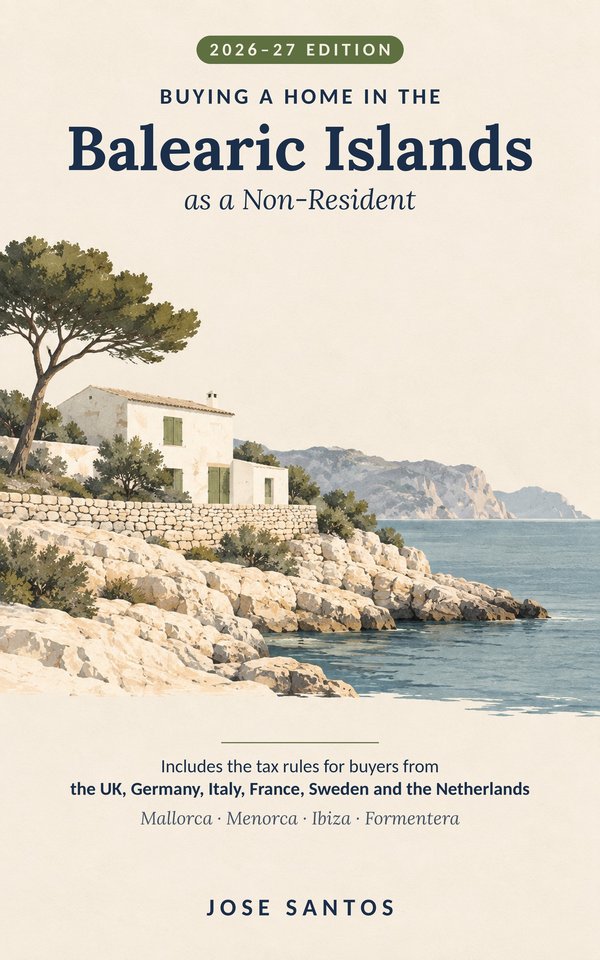
More detail in the book. Chapters 8 and 14 of Buying a Home in the Balearic Islands as a Non-Resident cover this with worked examples, deadlines and the risks behind the figures.
General information based on the rules in force in September 2026, not legal or tax advice. Rules change often: check your own case with an independent Spanish lawyer or tax adviser before you act.
Related: Can you let your Balearic home to holidaymakers? · How is a non-resident taxed on selling a Balearic home?