Buying a country house on rural land in the Balearics
A country house on rural land can be a sound buy in the Balearics, but it needs more legal checking than a flat or town house. What matters most is which type of rural land the plot is on, whether every structure was licensed and, for buyers from outside the EU, whether a military permit is needed. Settle all of it before you sign the private contract and pay the main deposit.
Two kinds of rural land
Balearic planning law divides rural land into two types. Ordinary rural land (suelo rústico común) is everyday farmland with no special protection. Protected rural land (suelo rústico protegido) covers designations such as ANEI, ARIP and APR: broadly the coast, the Tramuntana mountains and other areas of special natural or scenic value. The type is fixed by each island's territorial plan, not by how the land looks, so ask your lawyer to confirm it.
Unlicensed work and the time limits
Article 196 of the Balearic planning law (LUIB) sets how long the authorities have to act against unlicensed work. Since a reform that took effect on 14 December 2024, it depends on the land:
| Land and situation | Time limit for the authorities |
|---|---|
| Protected rural land | None: demolition can be ordered at any time |
| Ordinary rural land, current rule | Eight years from completion, as for urban land |
| Ordinary rural land, work finished before 2018 | Eight years under the earlier law, so generally no longer demolishable |
From 2018 to December 2024 there was no time limit on any rural land. For ordinary rural land, work finished in that period is a grey area, and your lawyer will need to look at the plot and the dates.
Work too old to be demolished is still not fully legal. It is classed as outside planning rules (fuera de ordenación) and cannot simply be enlarged or rebuilt. The risk also passes with the property: buy a house on protected land with an unlicensed pool and you take on the risk of removing it.
Legalising older buildings
A 2024 Balearic decree-law opened a one-off window to legalise rural buildings and uses that could no longer be demolished. Once an island council approves it in a full session, owners have three years to apply, with a technical project, environmental improvements and a payment to the town hall of 10%, 12.5% or 15% of the construction cost, depending on the year of application.
At the time of writing (September 2026), all four councils have approved it: Menorca in July 2024 and again in March 2025, Ibiza in 2024 (confirmed in 2025), Mallorca in February 2025 and Formentera in May 2026. Mallorca's window closes in February 2028, Menorca's in March 2028 and Ibiza's in April 2028. Homes legalised this way cannot be let to tourists unless they already held a tourist letting title before 29 May 2024, and this is recorded at the Land Registry.
If something is unlicensed but eligible, make legalisation by the seller a condition of the sale, or take the cost off the price.
The military permit for non-EU buyers
A 1975 defence law treats every Spanish island as a sensitive area. Buyers who are not citizens of an EU country, including the British since Brexit and the Swiss and Norwegians, need prior authorisation from the Ministry of Defence to buy rural land in the Balearics.
- A Spanish company needs it too if non-EU owners hold more than half of it or control it.
- No more than 15% of the land in a municipality may be in foreign hands; where that is reached, applications can be refused.
- Without the permit, the notary cannot authorise the purchase and it cannot be registered in your name.
Have your lawyer apply once you have a reservation, and make the private contract conditional on the permit.
Land Registry and Catastro
The Land Registry is the legal record of ownership, showing the owner, mortgages, seizures and rights of way. The Catastro is the tax record, showing the physical description, plot and cadastral value. Get a nota simple from the Registry, which costs a few euros, before paying any deposit and again just before completion.
Then compare both records with what is on site. A pool, annex or extra floor in one record but not the other suggests it was built without a licence or never declared. Check the Catastro reference value too: transfer tax is charged on it if it is higher than your price, which the free calculator can show.
Water, drainage and electricity
None of this appears in the Land Registry. Ask whether water comes from the mains, a well that needs its own authorisation, or a cistern topped up by tanker in summer. Without a sewer, a septic tank or treatment plant needs authorisation and registration for the Balearic sanitation charge, whose arrears can pass to you. Check the electricity is a legal, metered supply with a current installation certificate.
Debts that pass to the buyer
- Local property tax (IBI): ask for the last paid receipt or a certificate that nothing is owed.
- Community fees, where there are shared areas: the property answers for the current year and the three previous calendar years, so get a certificate from the administrator.
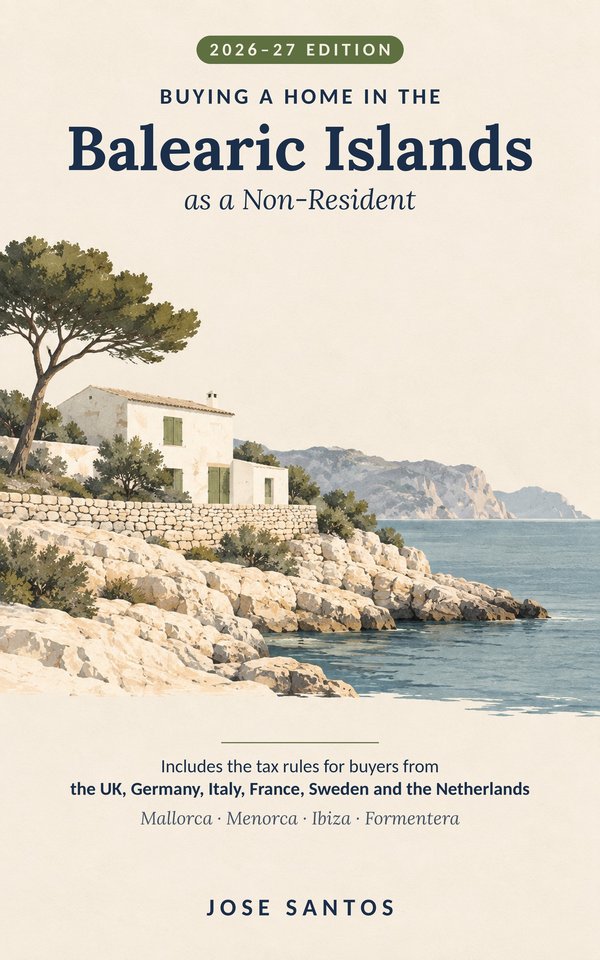
More detail in the book. Chapters 3, 4 and 6 of Buying a Home in the Balearic Islands as a Non-Resident cover this with worked examples, deadlines and the risks behind the figures.
General information based on the rules in force in September 2026, not legal or tax advice. Rules change often: check your own case with an independent Spanish lawyer or tax adviser before you act.
Related: What does a non-resident pay each year on a Balearic home? · Can you let your Balearic home to holidaymakers?