The 3% withholding when selling in Spain: refunds
When a non-resident sells a home in Spain, the buyer must keep back 3% of the price and pay it to the Spanish tax agency on form 211, within one month, as an advance on the seller's tax. The seller then files form 210 roughly four months after signing. If the real tax is less than the 3%, or the sale made a loss, the seller claims the difference back; if it is more, the seller pays the balance. The rules are national, so they are the same in the Balearic Islands and on the Costa Blanca.
Who withholds, and why
The 3% is not a separate tax. Spain taxes a non-resident's gain on a sale at 19%, whether they live inside or outside the EU, and the 3% is simply collected in advance by the buyer. Spanish law makes the buyer responsible for it: on the day of signing, the buyer keeps back 3% of the price in the deed and pays it to the tax agency on the seller's behalf.
If the buyer fails to do this, the tax office can recover the money from the property the buyer has just bought. That is why buyers' lawyers write the withholding into the private contract and the completion statement from the start.
Your buyer's lawyer may also ask to hold back an estimate of the municipal gains tax (plusvalía municipal). It is the seller's tax, but when the seller is a non-resident the buyer can be pursued for it. The deadline is 30 working days from the sale.
The forms
| Form | Who files it | What it is for | Deadline |
|---|---|---|---|
| 211 | The buyer | Paying the 3% to the Spanish tax agency | Within one month of signing |
| 210 | The seller | Declaring the gain and claiming a refund or paying the balance | Within three months of the end of the buyer's one-month deadline, so roughly four months after signing |
Ask the buyer or their lawyer for a copy of form 211. You need it to claim the money back.
How the refund works
On form 210 you work out your real tax. Your taxable gain is the sale price, minus the costs of selling, minus what the home cost you: the purchase price, the taxes and fees you paid when buying, and any improvements you can prove with invoices, less depreciation on the building for any years it was let. The plusvalía municipal you pay counts as a selling cost. Tax is 19% of that gain. The 3% already withheld is then deducted:
- If your tax is lower than the amount withheld, or you sold at a loss, you ask for the difference to be refunded.
- If your tax is higher, you pay the balance with form 210.
The tax agency has six months to pay a refund. After that, it owes you interest.
Both books work through an example. In the Balearic one, a home bought in 2015 for €400,000 and sold for €750,000 leaves €46,075 of tax; the buyer has already withheld €22,500, so €23,575 is still to pay. In the Costa Blanca one, a villa bought in 2015 for €250,000 and sold for €450,000 leaves €25,080 of tax, of which €13,500 was withheld, so €11,580 is still to pay. In both, the invoices for improvements made a difference of several thousand euros. The full figures are in the guides to selling in the Balearics and on the Costa Blanca.
Where the refund is paid
You need a bank account to receive the refund, but it does not have to be Spanish: a Spanish or a foreign account will do. Make sure your NIE and bank details are in order before you sign, so the refund has somewhere to land. If you cannot be in Spain for the signing, a lawyer can sign for you with a notarised power of attorney.
The timeline
| When | What happens |
|---|---|
| Signing day | Deed signed; buyer keeps back 3% of the price, and often an estimate of the plusvalía |
| Within 30 working days | Seller (or buyer, from the amount held back) files and pays the plusvalía |
| Within 1 month | Buyer pays the 3% to the tax agency on form 211 |
| About 4 months after signing | Seller files form 210, claiming a refund or paying the balance |
| Up to 6 months after filing | Tax agency pays any refund, with interest if late |
If you are the buyer
If you buy from a non-resident, the 3% is not an extra cost for you, but it must be deducted from the price and paid on time. Make the withholding, and the estimated plusvalía, a term of the private contract and check that both appear in your lawyer's completion statement. Forgetting the 3% withholding is one of the most common mistakes buyers make. See the buying process step by step.
Two habits make a large difference to what a seller finally pays: keeping every invoice from the day you bought, and filing your return on time. For your own sale, ask a Spanish tax adviser to prepare form 210.
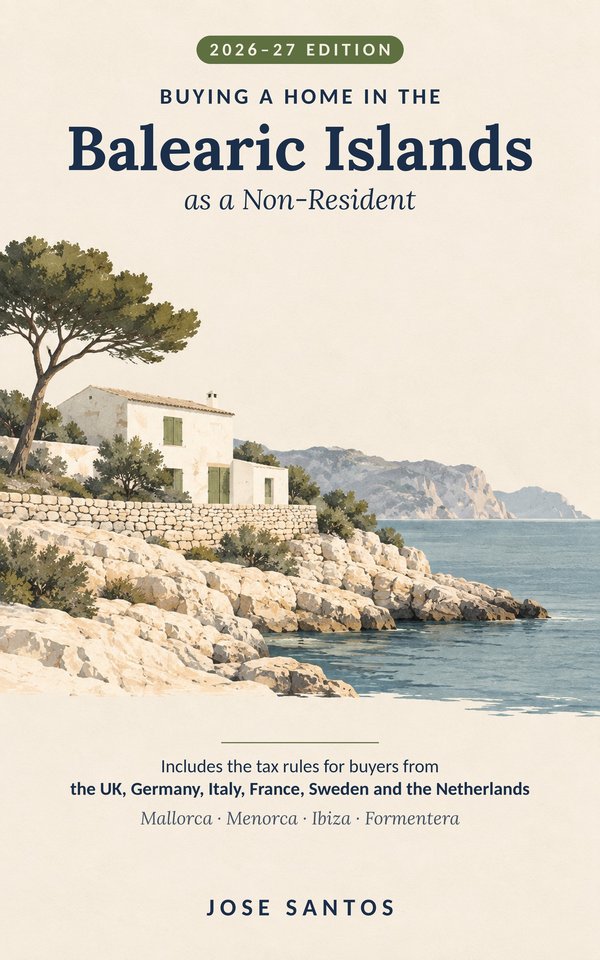
More detail in the book. Chapter 10 of Buying a Home in the Balearic Islands as a Non-Resident cover this with worked examples, deadlines and the risks behind the figures.

More detail in the book. Chapter 10 of Buying a Home on the Costa Blanca as a Non-Resident cover this with worked examples, deadlines and the risks behind the figures.
General information based on the rules in force in October 2026, not legal or tax advice. Rules change often: check your own case with an independent Spanish lawyer or tax adviser before you act.
Related: How much does it cost to buy a home in the Balearic Islands? · How much does it cost to buy a home on the Costa Blanca?