Read a sample
This free sample contains the full list of contents, the introduction and Chapter 6, What Buying Really Costs, including the worked example. Rules as in force in September 2026.
Contents
- Introduction
- Chapter 1 — Before You Start
- Chapter 2 — Choosing Your Island and Area
- Chapter 3 — The Buying Process, Step by Step
- Chapter 4 — The Legal Checks
- Chapter 5 — Renovating and Building Work
- Chapter 6 — What Buying Really Costs
- Chapter 7 — Financing Your Purchase
- Chapter 8 — The Yearly Cost of Owning
- Chapter 9 — Renting Out Your Home
- Chapter 10 — Selling Your Home
- Chapter 11 — Leaving Your Home to Your Children
- Chapter 12 — Making the Move: Becoming Resident
- Chapter 13 — Country Annex: Your Taxes at Home
- Chapter 14 — Four Owners, Start to Finish
- Appendix — Scenarios Compared
- Useful Official Resources
- Glossary of Spanish Terms
- Your Free Calculator
Introduction
This book is for anyone who lives outside Spain and is thinking of buying a home in the Balearic Islands: Mallorca, Menorca, Ibiza or Formentera. It follows the life of a property in the order you will meet each question, from the paperwork you need before you start looking, through the purchase, owning and letting the home, to selling it or leaving it to your children.
Most guides to buying in Spain are written for residents, or for Spain as a whole. The Balearics have their own taxes, their own tourist letting rules and their own planning rules for rural land, and many of the tax breaks you will read about do not apply to non-residents. This book is about that combination: a non-resident buyer and a Balearic home.
Three things make it different:
Figures you can check. Every tax rate and threshold is taken from official Spanish sources where possible, and the book tells you when a figure is an estimate or a market practice rather than a rule.
Worked examples. Most chapters follow the same €750,000 home through the numbers, so you can see what each cost looks like in practice, and Chapter 14 follows four typical owners from the first offer to the question of who inherits.
Your country as well as Spain. Chapter 13 explains how Germany, the United Kingdom, Italy, France, Sweden and the Netherlands tax the same home, because Spanish tax is only half the story.
An appendix at the end compares the main choices side by side: cash or mortgage, letting or not, selling, inheriting, and staying non-resident or moving to the islands.
How current is it? The book reflects the rules in force in September 2026. Spanish and Balearic rules change often, and several changed in 2025 and 2026 alone. Each edition is updated.
What it is not. This book is general information, not legal or tax advice for your situation. Before you sign anything, and before relying on any figure in this book, take advice from an independent Spanish lawyer and, where relevant, a tax adviser in your country of residence. Where the book flags a point as uncertain or likely to change, check the current position before you act.
Chapter 6 — What Buying Really Costs
The 10% rule
If you are buying a resale home in the Balearic Islands as a non-resident, budget around 10% of the price on top of the price itself. Almost all of that is tax. The notary, the Land Registry and your professionals account for a small share.
That figure surprises many buyers from northern Europe, where purchase costs are often lower. It also catches out people who read Spanish property guides written for residents. Several of the tax breaks you will see advertised simply do not apply to you.
Resale homes: transfer tax (ITP)
When you buy a home from a private seller, you pay the Balearic transfer tax, the Impuesto sobre Transmisiones Patrimoniales, usually shortened to ITP. It is a regional tax, collected by the Balearic tax agency (ATIB), and it is the biggest cost of the purchase.
The Balearics use a banded scale that rises with the value of the property:
| Property value | Rate on that band |
|---|---|
| Up to €400,000 | 8% |
| €400,000 – €600,000 | 9% |
| €600,000 – €1,000,000 | 10% |
| €1,000,000 – €2,000,000 | 12% |
| Over €2,000,000 | 13% |
How the calculation works. You do not pay 10% on the whole price of a €750,000 home. Each band is taxed at its own rate, the results are added up, and that total is turned into an average rate with two decimals. That average rate is then applied to the full taxable value. In practice the result is almost identical to a simple band-by-band sum, but it explains why your notary's figure may differ from an online calculator by a few tens of euros.
Deadline. The tax must be paid within one month of signing the deed, using form 600. In most purchases your lawyer or the notary's gestoría files it for you, but the legal obligation is yours.
The reduced rates are not for you. You will see Balearic rates of 4%, 2% and even 0% advertised. All of them require the home to become the buyer's main residence, and the property value to stay under a low threshold. A holiday home owned by a non-resident always pays the standard scale.
The reference value trap
Since January 2022, transfer tax is not always calculated on the price you pay. Spain's property survey office, the Catastro (not to be confused with the Land Registry), assigns every property a valor de referencia, or reference value. The tax is charged on whichever is higher: that reference value or the price in the deed.
If you negotiate a good deal on an old farmhouse and pay less than its reference value, you will be taxed on money you never paid. This happens more often than buyers expect with older rural properties in the islands, which is why it is worth asking your lawyer to check the property's reference value on the Catastro's online portal before you sign the reservation contract; if it is higher than the agreed price, factor the extra tax into your offer.
The reference value only matters for resale homes. On a new build bought from a developer, VAT is charged on the contract price.
New builds: VAT and stamp duty
If you buy a newly built home directly from the developer, you do not pay transfer tax. You pay VAT instead, plus a stamp duty on the deed.
| Tax | Rate |
|---|---|
| VAT (IVA) on a new home | 10% |
| Stamp duty (AJD) on the deed | 1.5% |
| Stamp duty if the property is worth €1,000,000 or more | 2% |
The VAT is paid to the developer with the price and passed on to the Spanish tax authorities. The stamp duty, Actos Jurídicos Documentados or AJD, is a Balearic tax paid within one month of signing, like ITP.
As with transfer tax, there are reduced stamp duty rates for residents buying their main home. They do not apply to a non-resident's holiday home.
A "new" home is only treated as new on its first sale by the developer. If the first owner later sells it to you, you pay transfer tax on the resale scale.
When the seller is also a non-resident
Many sellers in the Balearics are foreigners who do not live in Spain. If yours is one of them, Spanish law makes you, the buyer, responsible for two of the seller's taxes. Neither is an extra cost for you, but both must be deducted from the price and paid on time.
The 3% withholding. You must keep back 3% of the price in the deed and pay it to the Spanish tax agency on the seller's behalf, using form 211, within one month of signing. On a €750,000 home that is €22,500 that goes to the tax office, not to the seller. The seller later reclaims any excess through their own non-resident tax return.
If you fail to do this, the tax office can recover the money from the property you have just bought. That is why it must be written into the private contract and reflected in the completion statement from the start.
The municipal gains tax. Every Spanish town hall charges a tax on the increase in land value when a property is sold, the plusvalía municipal. It is the seller's tax, but when the seller is a non-resident the town hall can claim it from the buyer. The deadline is short, 30 working days from the sale, so ask your lawyer to estimate the plusvalía before completion and withhold that amount from the price as well, alongside the 3%.
Notary, Land Registry and professionals
After the taxes, the remaining costs are modest. Notary and Land Registry fees are set by law and are identical everywhere in Spain. Professional fees are not.
Every Spanish property sale is signed before a notary, who checks identities, reads the deed aloud and confirms that taxes and charges are in order. The notary's fee follows an official scale whose rate falls as the price rises: for a €750,000 home the base fee is about €575, with copies, pages and 21% VAT added on top.
Registering the deed in the Land Registry (Registro de la Propiedad) is what protects your ownership against third parties. Its fee also follows an official scale: about €320 plus VAT for a €750,000 home, and never more than roughly €2,200, however expensive the property.
Your lawyer, gestoría and valuer set their own fees, so ask each of them for a written quote that states whether VAT is included.
If you take a mortgage. Since 2019 the bank pays the notary, registry, gestoría and stamp duty on the mortgage deed. You pay the bank's valuation of the property. Spanish banks usually lend non-residents a lower share of the value than residents, which is covered in Chapter 7.
Worked example: a €750,000 home
A resale villa bought for €750,000 from a non-resident seller costs about €66,000 in taxes and fees, and requires you to withhold another €22,500 from the price. The example assumes the reference value is below the price and excludes professional fees.
| Item | Resale (€) | New build (€) |
|---|---|---|
| Transfer tax: 32,000 + 18,000 + 15,000, at an average rate of 8.67% | 65,025 | — |
| VAT at 10% | — | 75,000 |
| Stamp duty at 1.5% | — | 11,250 |
| Notary and Land Registry, base fees before VAT and copies | 893 | 893 |
| Total taxes and fees | 65,918 | 87,143 |
| 3% withheld for the seller's tax, if the seller is non-resident (part of the price, not a cost) | 22,500 | — |
Checklist before you sign
Check the Catastro reference value against the agreed price.
Confirm whether the seller is resident in Spain for tax purposes.
If not, write the 3% withholding and the estimated plusvalía into the private contract.
Get written quotes from your lawyer, gestoría and valuer.
Make sure your funds cover the price plus around 10%.
Agree who files form 600 and form 211, and diarise the one-month deadlines.
End of the sample. The full book continues with financing, the yearly cost of owning, letting, selling, inheritance, becoming resident, how your own country taxes the home and four case studies.
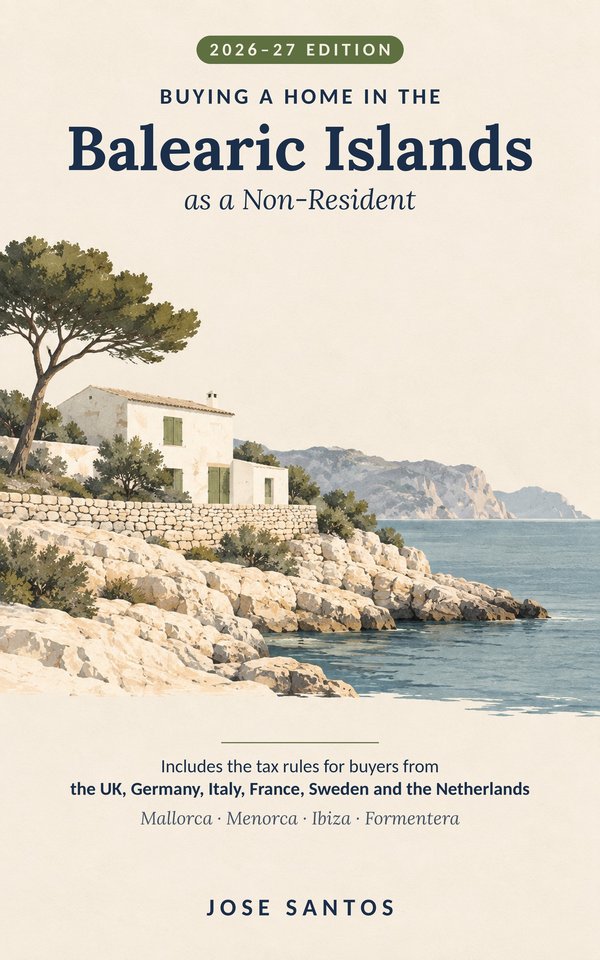
Buying a Home in the Balearic Islands as a Non-Resident (2026–27 edition) covers the whole process, from the first offer to who inherits, with worked examples and deadlines.
© 2026 Jose Santos. Sample shared for reading on this site. General information, not legal or tax advice.