Can you let your Balearic home to holidaymakers?
Yes, but only under tight conditions. The home must be a house rather than a flat, sit in an area zoned for holiday lets, have served as a private residence for five years or more, hold a tourist licence and have tourist places attached to it. For most buyers, that means a house which already holds a valid licence.
What has closed
At the time of writing (September 2026), two rules stand out:
- Flats in apartment blocks have been unable to get a new tourist licence on any island since April 2025.
- In 2026 Palma stopped accepting new holiday lets in homes of any kind.
Outside Palma, very few new tourist places are being released. Each island council and town hall decides its own zoning, which can change, so check the exact address rather than relying on the island as a whole. If letting income matters, either buy a home with a licence already in place or get it confirmed in writing that one can be obtained, before signing the reservation contract.
The licence types
A Balearic holiday let is an estancia turística en vivienda (ETV): letting the entire home (rooms cannot be let separately) for a maximum stay of one month. There are three licences:
- ETV: a detached house or a house on its own plot. It has no expiry date and is open to non-residents.
- ETVPL: a home in a building under shared ownership, valid for 5 years and renewable. Since April 2025 it is limited to houses (terraced, semi-detached or detached) on a shared plot; flats are excluded.
- ETV60: the owner's main home, let for up to 60 days a year, valid for 5 years. You must be registered as living there, so it is not available to a non-resident.
The home must also be free of serious planning infringements, and one owner can hold tourist lets on three homes at most.
Tourist places
Each licensed home needs one tourist place (plaza turística) for each guest it may accommodate. Places are bought from a pool that each island runs, or transferred from another owner, and the price differs from island to island. If you buy a licensed home, your lawyer should check the licence on the island's tourist register, confirm the number of places and make sure the licence transfers to you.
Licensed houses are scarce and cost more. In a Mallorca case study in the book, a detached house licensed (ETV) for eight guests had an asking price of €950,000, against €800,000 for a similar unlicensed house nearby.
Registration number and penalties
To start, you submit a DRIAT, a responsible declaration, to the island council before any guest arrives. When it is accepted, the home is entered on the island register and given an ETV number. That number has to be shown in all advertising, on whichever platform.
A national registration number (the NRUA) was required from July 2025, until the Supreme Court annulled it in May 2026, ruling that registers of this kind are a matter for the regions. Here, the island number is what counts.
Unlicensed letting, or even advertising, is treated as a serious offence. The maximum fine has been €500,000 since April 2025, and in 2026 the Balearic government took steps to add daily penalties of up to €5,000 for as long as the letting goes on.
Guest registration and the tourist tax
Each guest has to be registered on SES Hospedajes, the national police system. You also charge your guests the Balearic sustainable tourism tax (the ecotasa) and pay it over to the Balearic Tax Agency. Payment of the tax cannot be postponed or spread over instalments.
| Period | Per guest, per night |
|---|---|
| 1 May to 31 October | €2.00 plus 10% VAT: €2.20 |
| 1 November to 30 April | 75% lower: €0.50 plus VAT, €0.55 |
| From night nine of a single stay | Halved again |
| Guests under 16 | Exempt |
For a week in August, two adults and their children of 10 and 14 pay 2 × 7 × €2.20, or €30.80, because the children are exempt.
How the rent is taxed
Rent is taxed in Spain through non-resident income tax on form 210. Where you live decides the rate:
- Residents of the EU, Iceland, Norway or Liechtenstein pay 19% on net income. Deductible costs, apportioned to the days let, include IBI, community fees, insurance, repairs, mortgage interest and depreciation.
- Residents anywhere else, the UK included, pay 24% on the gross rent, with no deductions.
On €40,000 of rent with €16,000 of expenses, that means €4,560 for an EU resident and €9,600 for a UK resident. For days the home is empty or used by you, notional income tax applies instead. You can try your own figures in the free calculator.
Since Order HAC/623/2026, rent is reported annually, in the window from 1 to 20 April after the year ends (or 1 to 15 April if paying by direct debit). Income from 2026 is due in April 2027. As a transition, owners who file each letting separately keep the old quarterly deadlines for January to September 2026. Your home country may tax the same income as well.
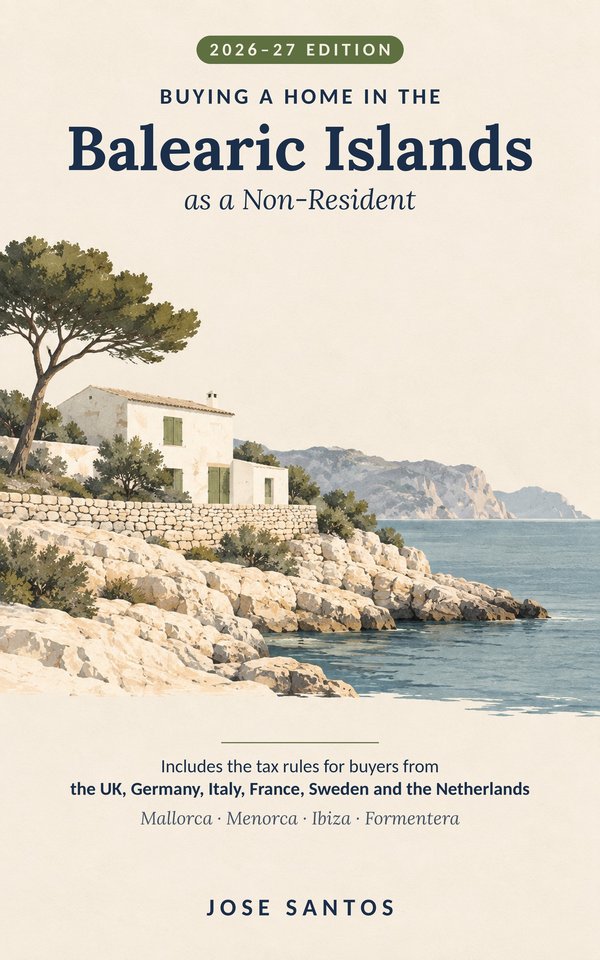
More detail in the book. Chapters 9 and 14 of Buying a Home in the Balearic Islands as a Non-Resident cover this with worked examples, deadlines and the risks behind the figures.
General information based on the rules in force in September 2026, not legal or tax advice. Rules change often: check your own case with an independent Spanish lawyer or tax adviser before you act.
Related: How is a non-resident taxed on selling a Balearic home? · Inheritance tax on a Balearic home when heirs live abroad