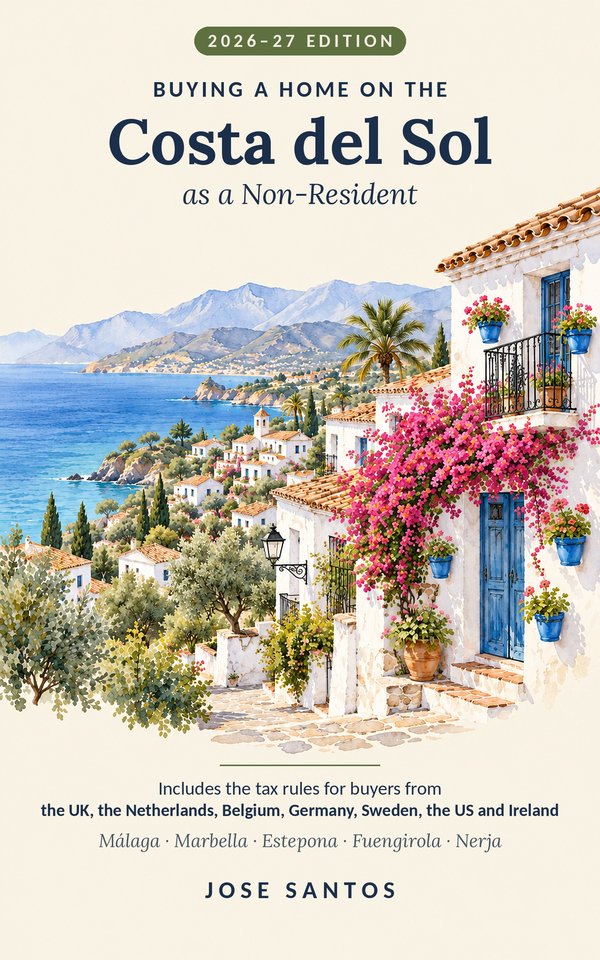
Málaga · Marbella · Estepona · Fuengirola · Mijas · Nerja · 2026–27 edition
Buying a Home on the Costa del Sol as a Non-Resident
A practical guide for buyers who live outside Spain. It follows a home through its life, from buying and owning to letting, selling and leaving it to your children, and answers the questions buyers from abroad ask at each step.
- Rules in force in October 2026
- Worked examples with real figures
- How seven home countries tax the same house
- Paperback and Kindle
Start here
Buying
What it costs, what to check and the order to do it in.
Owning and letting
The tax you pay every year, and the rules for holiday lets.
Selling
Tax on the gain, and the 3% your buyer keeps back.
Inheriting
What your children or other heirs would pay, in Spain and at home.
It answers questions such as
- Can I buy as a foreigner?And what you need before you start looking: NIE, bank account, power of attorney.
- What does buying cost on top of the price?Andalusia's flat 7% transfer tax, VAT and stamp duty on new builds, fees and the Catastro reference value.
- How does the process work, from offer to keys?Reservation, deposit, private contract, the notary, buying off-plan and whose name to buy in.
- What should my lawyer check before I sign?Country houses built without a licence and the AFO declaration, urbanisations never handed over, Marbella's planning legacy, flood risk.
- What work can I do on the house?Which licences or declarations you need, what the work costs in tax, and the limits on rural land and near the coast.
- Can I let the home to holidaymakers?The Andalusian Tourism Register, Málaga city's freeze on new lets, the limits in other towns, and how rent is taxed.
- What do I pay each year as a non-resident?Non-resident income tax, IBI, and why Andalusia's wealth tax reduction only works if you file.
- What happens when I sell?Tax on the gain, and how the 3% your buyer withholds is settled through your own return.
- What if I leave it to my children?The €1 million allowance and 99% reduction, the large bill for brothers, sisters, nephews and nieces, gifts and wills.
- How does my own country tax the home?The UK, the Netherlands, Belgium, Germany, Sweden, the United States and Ireland.
Inside the book
- 1. Before You StartNIE, bank account, power of attorney, and whether you need a tax representative.
- 2. Choosing Your AreaThe coast from Manilva to Nerja, Málaga city, the Axarquía and the towns inland.
- 3. The Buying Process, Step by StepFrom the offer to the notary, whose name to buy in, off-plan purchases and avoiding scams.
- 4. The Legal ChecksLand Registry, licences, rural land and AFO houses, urbanisations, Marbella, flood maps and debts that come with the house.
- 5. Renovating and Building WorkWhich work needs which licence, what it costs in tax, and the limits on rural land and the coast.
- 6. What Buying Really CostsThe 7% transfer tax, VAT, stamp duty, the reference value and fees.
- 7. Financing Your PurchaseMortgages for non-residents and what banks lend.
- 8. The Yearly Cost of OwningNon-resident income tax, IBI, wealth tax and the forms to file.
- 9. Renting Out Your HomeRegistration, Málaga's freeze and other town limits, guest registration and tax on rent.
- 10. Selling Your HomeTax on the gain, the 3% withholding and the municipal plusvalía.
- 11. Leaving Your Home to Your ChildrenAndalusian inheritance and gift tax, wills and the EU rules.
- 12. Making the Move: Becoming ResidentWhat changes, in tax and paperwork, if you move to Spain.
- 13. Country Annex: Your Taxes at HomeThe UK, the Netherlands, Belgium, Germany, Sweden, the United States and Ireland.
- 14. Four Owners, Start to FinishFour case studies, from a British couple in Fuengirola to Irish heirs of a country house in the Axarquía.
Plus: scenarios compared side by side, a directory of official sources, and a glossary of Spanish terms.
Try the numbers on your own home
The free calculator that goes with the book estimates the Spanish taxes on buying, owning, letting, selling and inheriting, plus what your own country may add. It runs in your browser and needs no sign-up.
The calculator's starting example: the book's €450,000 resale townhouse in Mijas Costa
Owner resident in the Netherlands, rules in force in October 2026.
Keep your figures up to date
Get the calculator as a spreadsheet and a short email when Spanish or Andalusian rules change. No more than a few emails a year.
Common questions
How much does it cost to buy a home on the Costa del Sol as a non-resident?
Budget around 8% to 9% of the price for a resale home, or 12% to 13% for a new build. Andalusia charges a single 7% transfer tax on the whole value, whatever the price, on the higher of the price and the Catastro reference value. In the book's worked example, a €450,000 resale townhouse in Mijas Costa costs €32,207 in tax and notary and Land Registry base fees; with a lawyer's fee of around 1% plus VAT, the total is about €37,650, or 8.4% of the price.
Can I let my Costa del Sol home to tourists?
It depends on the town and the building. Every holiday let must be registered in the Andalusian Tourism Register (RTA), the town's planning rules must allow tourist use at that address, and since April 2025 a new let in a flat needs the approval of three-fifths of the owners. Málaga city accepts no new holiday lets anywhere until as late as August 2028, Manilva and Fuengirola restrict them, and Marbella still accepts them. If letting matters, buy a home that is already registered or get the town hall's confirmation first. From 1 December 2026, stays of 30 nights or fewer also carry 10% VAT, if the October 2026 housing decree is confirmed.
Do I pay tax every year if I don't let the home?
Yes. Non-resident owners pay tax on notional income even if the home is never let: 2% of the cadastral value in most Costa del Sol towns, including Mijas and Fuengirola, whose values were last revised long ago (1.1% where a general revaluation took effect in the last ten years). It is taxed at 19% for residents of the EU, Iceland, Norway or Liechtenstein and 24% for everyone else, including the UK and US. For the book's townhouse, with a cadastral value of €150,000, that is €570 or €720 a year, on form 210. From 2027, a housing decree in force since 8 October 2026 would replace both rates with a banded scale from 1.1% to 3% on the owner's total cadastral value, if parliament confirms it by early November 2026.
How much inheritance tax will my children pay on a Costa del Sol home?
Usually none in Spain. Under Andalusian rules, children, grandchildren, spouses and parents each deduct €1,000,000 from what they inherit, and any tax left is reduced by 99%, whether they live in Spain or abroad. The book's €450,000 townhouse passes to a son or daughter, or to two children, with no Spanish tax. The return must still be filed within six months. Your own country may tax the home: if the parent lived in the Netherlands, a child would pay about €68,900 in Dutch tax, with nothing Spanish to credit.
What if a brother, sister, nephew or friend inherits?
Then the Spanish bill is large. Brothers, sisters, nephews, nieces, uncles, aunts and in-laws get only a €10,000 allowance and a multiplier of 1.5, with no reduction; cousins and unrelated heirs get no allowance and a multiplier of 1.9. On the €450,000 townhouse a brother would pay about €127,800, more than on the Costa Blanca for a death from June 2026, and an unrelated friend about €166,500. If your heirs will not be your children, take advice early.
What should my lawyer check on a country house?
First, how the land is classified and whether every structure has a licence. Andalusian planning law, the LISTA, gives the authorities six years from completion to act against unlicensed work, but on some land there is no limit, such as next to rivers, close to the coast or on rural land at risk of flooding while the risk lasts; illegal subdivisions of rural land can also be pursued at any time. A house without a licence should have an AFO declaration from the town hall, which lets it be registered and connected to utilities. Check the water supply, septic tank, electricity and the national flood map (SNCZI) too.
Is it safe to buy in Marbella, given its planning history?
The homes concerned are lived in, registered and bought and sold, but ask your lawyer to check the specific property. Around 18,000 Marbella homes were built under licences that did not match the town plan of 1986, and the 2010 plan meant to regularise them was annulled by the Supreme Court in 2015. A new general plan received final approval on 18 September 2026 and takes effect once published in the provincial gazette; the detailed planning for each area is still being prepared. Ask whether the home is affected and what the new plan says about its area.
Can I get a Spanish mortgage as a non-resident?
Yes, but expect to borrow less than a resident: typically 60% to 70% of the value if you live in the EU and 50% to 60% if you live outside it, applied to the lower of the price and the bank's valuation. On the Costa del Sol valuations are often well below asking prices, which shrinks the loan. Plan to fund 40% to 50% of the price yourself from the EU, or 50% to 60% from outside it. Many banks want the loan repaid by about age 75.
Will I pay wealth tax on a Costa del Sol home?
Almost certainly not. As a non-resident you are taxed only on assets in Spain, and if you opt for Andalusian rules you receive a 100% reduction of the wealth tax, so nothing is due unless your net Spanish assets exceed about €3.7 million. The catch is that the reduction only applies if you file form 714 and choose Andalusian rules whenever you are required to file. If your net Spanish assets exceed €700,000, or your gross Spanish assets €2 million, ask your adviser whether you must.
Short answers based on the 2026–27 edition. More in the glossary, the regional comparison and the list of rule changes.
About the book
How up to date is it?
The 2026–27 edition reflects the rules in force in October 2026, including Málaga city's freeze on new holiday lets, Marbella's new town plan, the end of the national NRUA registration number and the national housing decree of 6 October 2026, which was in force at the time of writing but needed parliamentary confirmation. Andalusian and town rules change often, so each edition is updated, and the book flags the points most likely to change.
I don't live in one of the seven countries in the annex. Is it still useful?
Yes. Everything except the country annex applies to any non-resident buyer. The annex covers the United Kingdom, the Netherlands, Belgium, Germany, Sweden, the United States and Ireland; for other countries, the book tells you what to ask a local adviser.
Does it cover the whole Costa del Sol?
Yes: the coast of the province of Málaga, from Manilva and Estepona in the west, through Marbella, Fuengirola and Málaga city, to Nerja in the east, together with the hill towns just inland, such as Mijas Pueblo, the Alhaurín towns, Coín and the villages of the Axarquía. The Andalusian tax rules in the book apply across Andalusia.
Is it legal or tax advice?
No. It is general information to help you understand the process and the numbers, and to ask the right questions. Before you sign anything, take advice from an independent Spanish lawyer and, where relevant, a tax adviser in your own country.
Paperback or Kindle?
Both have the same content. The paperback is 6 × 9 inches; the Kindle edition works on any Kindle device or the free Kindle app.
Do I need the book to use the calculator?
No. The calculator is free and needs no sign-up. The book explains where each figure comes from, the risks behind them and the deadlines.