Inheritance tax on a Costa del Sol home when you live abroad
Andalusia is one of the most generous regions in Spain when parents leave a home to their children. Children, grandchildren, spouses and parents who inherit each deduct €1,000,000 from what they receive, and any tax left is reduced by 99%. Heirs who live abroad receive the same treatment. For brothers, sisters, nephews, nieces and friends the picture is very different.
Which rules apply when you live abroad
Since July 2021, every non-resident, inside or outside the EU, can apply the regional rules instead of the less generous state ones. If the person who died lived abroad and owned a Costa del Sol home, the Andalusian rules apply when Andalusia holds the greatest value of their Spanish assets. When the heir lives abroad, the return goes to the Spanish tax agency's national office in Madrid, not to the Andalusian tax agency, within six months of the death, on forms 650 and 660. It can be extended by six more months if the heirs ask within the first five.
What each heir would pay
| Heir | Allowance | Multiplier | Reduction of the tax |
|---|---|---|---|
| Children, grandchildren, spouses, parents (groups I and II) | €1,000,000 | 1.0 | 99% |
| Brothers, sisters, nephews, nieces, uncles, aunts, in-laws (group III) | €10,000 | 1.5 | None |
| Cousins, distant relatives, unrelated people (group IV) | None | 1.9 | None |
The value inherited, less the allowance, is taxed on the Andalusian scale, from 7% to 26%; the result is multiplied by the multiplier; and for close family the 99% reduction is applied. On a €450,000 townhouse:
- A son or daughter, or two children with half each: nothing.
- A brother: about €127,800, roughly 28% of the value.
- An unrelated friend: about €166,500, roughly 37% of the value.
A brother would pay about €15,500 more than on the Costa Blanca, where a new Valencian relief applies for deaths from June 2026. If your heirs will be brothers, sisters, nephews or nieces, take advice early, because there are few ways to reduce the bill. Unmarried partners registered in the Andalusian register of couples, or a similar public register elsewhere, are treated like spouses; ask your adviser whether a registration in your home country counts.
File on time, even when the tax is zero
The return must be filed within six months even when nothing is due, and late filing brings surcharges. The heirs also need an NIE each, a notarial deed accepting the inheritance and the plusvalía municipal, due within six months. Declaring a realistic market value, supported by a valuation, costs a child nothing in inheritance tax and lowers the gain when the home is later sold.
Gifts during your lifetime
Gifts between parents and children, grandparents and grandchildren, and spouses also carry a 99% reduction of Andalusian gift tax. A gift of property must be made in a Spanish public deed and declared on form 651 within 30 working days. That does not make a gift cheap: Spain taxes the giver on the gain as if the home had been sold, at 19% for a non-resident, and the plusvalía municipal is due. For a home bought long ago, inheriting is usually cheaper overall.
Your own country still counts
The Andalusian allowance removes Spanish tax, not the tax of the country where you or your heirs live. The United Kingdom (for long-term residents), the Netherlands, Belgium, Germany and Ireland tax the estate or the inheritance, including the Spanish home, and credit only the Spanish tax actually paid, which for a child is nothing. On the €450,000 townhouse left to one child:
| Where the parent lives | Home-country tax |
|---|---|
| Netherlands | About €68,900 |
| Belgium (Flanders, home as the only real estate) | About €73,500 |
| Ireland (child with no earlier gifts) | About €9,900 |
| Germany (home as the only asset) | About €3,500 |
| Sweden | None: no inheritance tax |
| United States | None unless the estate exceeds $15 million |
The Irish figure uses the thresholds announced in Budget 2027, subject to the Finance Bill. See the figures for your own case with the free calculator.
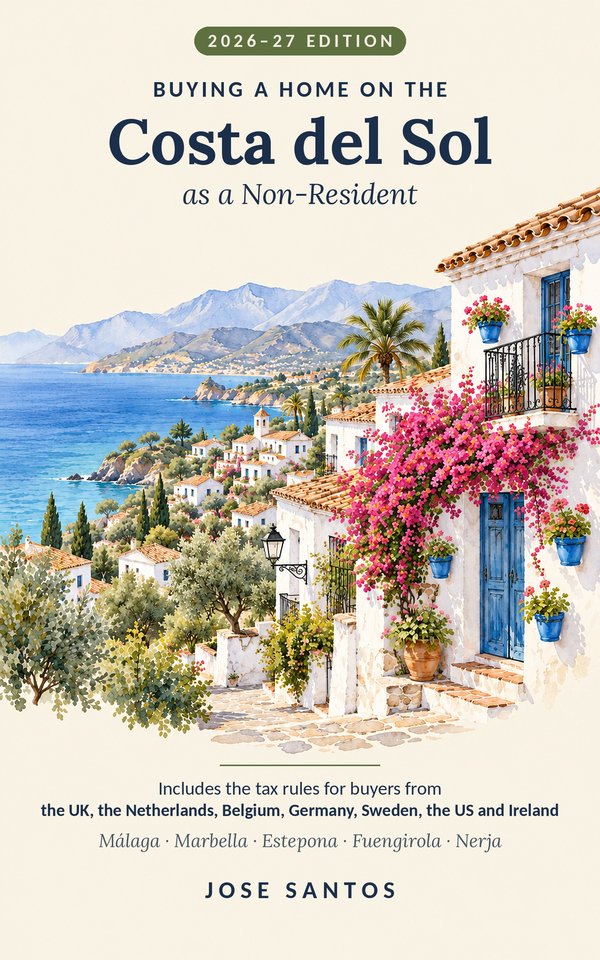
More detail in the book. Chapters 11 and 13 of Buying a Home on the Costa del Sol as a Non-Resident cover this with worked examples, deadlines and the risks behind the figures.
General information based on the rules in force in October 2026, not legal or tax advice. Rules change often: check your own case with an independent Spanish lawyer or tax adviser before you act.
Related: How much does it cost to buy a home on the Costa del Sol? · Legal checks before buying a country house or urbanisation home on the Costa del Sol