What does a non-resident pay each year on a Costa Blanca home?
Once the purchase is complete, a non-resident owner on the Costa Blanca pays two taxes every year: the town hall's property tax, and Spanish non-resident income tax, even if the home is never let. A third, wealth tax, only reaches owners with large assets in Spain.
Tax on income you never received
If you own a Spanish home that you do not let, Spain assumes it produces an income for you and taxes it. This notional income (renta imputada) is 1.1% of the cadastral value if that value has been revised in the last ten years, or 2% if it has not. It is taxed at 19% if you live in the EU, Iceland, Norway or Liechtenstein, and at 24% if you live anywhere else, including the United Kingdom.
The cadastral value is not the price you paid. It is an administrative value, usually much lower, shown on your IBI bill. Take a villa with a revised cadastral value of €150,000, not let at any point in the year:
| Dutch owner | British owner | |
|---|---|---|
| Notional income (1.1%) | €1,650 | €1,650 |
| Tax rate | 19% | 24% |
| Tax due | €314 | €396 |
A couple who own the home jointly each file for their own half, on form 210. From 2026 income onwards, the notional income return is filed between 1 April and 31 December of the following year.
If you let the home
Rent is taxed in Spain through the same non-resident income tax. Residents of the EU and EEA pay 19% on the net rent, after deducting expenses such as IBI, community fees, insurance, repairs and depreciation for the days let. Everyone else, including UK residents, pays 24% on the gross rent with no deductions. On €20,000 of rent with €8,000 of expenses, that is €2,280 against €4,800. Since June 2026, rental income is declared once a year, between 1 and 20 April of the following year. 2026 is a transition year: if you declare each letting separately, income from January to September 2026 keeps the old quarterly deadlines, the last of them in the first 20 days of October 2026. For the days you use the home or leave it empty, notional income tax applies instead.
IBI and the waste charge
Every town hall charges an annual property tax (IBI) on the cadastral value, at its own rate, plus a waste collection charge. The tax for the whole year falls on whoever owns the home on 1 January. In the province of Alicante many town halls have these taxes collected by the provincial office, SUMA, so your bill may come from SUMA. Pay by direct debit from a Spanish account: surcharges for late payment are automatic.
Wealth tax and the solidarity tax
As a non-resident you are only taxed on your assets in Spain, minus debts on them such as a Spanish mortgage, and you can choose the rules of the region where most of them are. With Valencian rules, a non-resident can plan on a tax-free allowance of €1,000,000 instead of the national €700,000. A Valencian law of July 2026 raises the allowance to €2,000,000 from the 2026 tax year, and official summaries describe it as a measure for residents of the region; whether a non-resident can use it too is not settled, so ask your adviser before you file. The Valencian allowance only applies if you file form 714 and choose Valencian rules, even when the result is zero.
The national solidarity tax only matters above €3.7 million of net Spanish assets, and any wealth tax you pay is deducted from it.
Your yearly calendar
- 1 January: whoever owns the home on this date owes the year's IBI.
- 1 to 20 April: form 210 for last year's rental income, if you let.
- 1 April to 31 December: form 210 for last year's notional income.
- Dates set by your town hall or SUMA: IBI and waste charge.
Try your own figures with the free calculator.
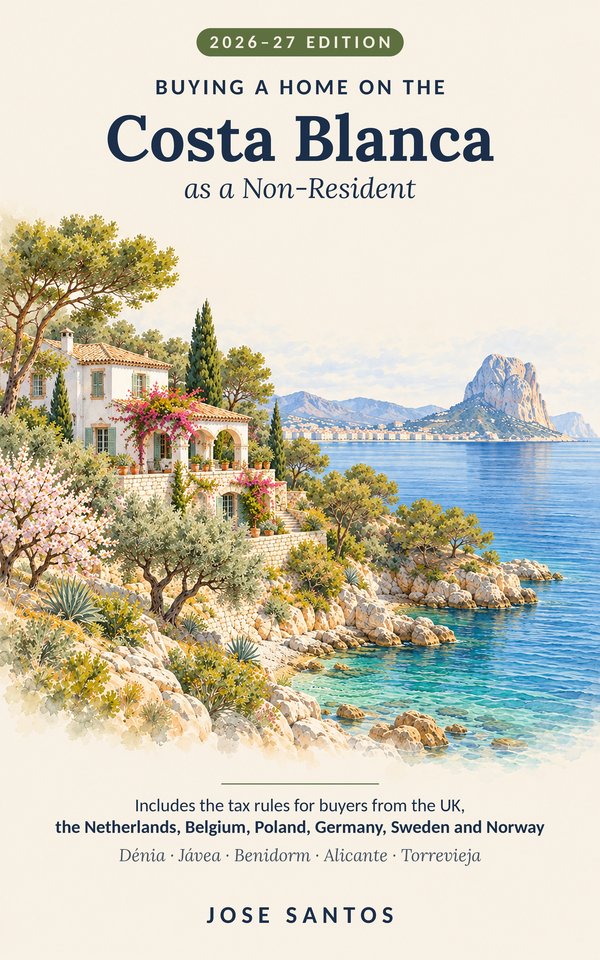
More detail in the book. Chapters 8 and 9 of Buying a Home on the Costa Blanca as a Non-Resident cover this with worked examples, deadlines and the risks behind the figures.
General information based on the rules in force in October 2026, not legal or tax advice. Rules change often: check your own case with an independent Spanish lawyer or tax adviser before you act.
Related: Can I let my Costa Blanca home to holidaymakers? · Selling a Costa Blanca home as a non-resident