Selling a Costa Blanca home as a non-resident
When you sell your Costa Blanca home, Spain taxes the gain at 19%, whether you live in the EU or elsewhere, and the town hall charges its municipal gains tax on the land. Because you are a non-resident, your buyer will keep back 3% of the price and pay it to the Spanish tax agency as an advance on your tax.
How the gain is calculated
Your taxable gain is the sale price, minus the costs of selling, minus what the home cost you: the purchase price, the taxes and fees you paid when buying, and any improvements you can prove with invoices, less depreciation on the building for any years it was let.
The 3% withholding and your return
On the day you sign, the buyer keeps back 3% of the price and pays it to the tax agency within one month, on form 211. Ask for a copy: you need it to claim the money back. You then file form 210 within about four months of the sale. If your tax is less than the 3% withheld, or you sold at a loss, you ask for the difference to be refunded, to a Spanish account or one abroad. The tax agency has six months to pay; after that it owes you interest.
A worked example
A villa bought in 2015 for €250,000, with €26,000 of purchase taxes and fees and €20,000 of documented improvements, never let, and sold for €450,000 with €22,000 of selling costs:
| Amount | |
|---|---|
| Net sale price | €428,000 |
| Total cost | €296,000 |
| Gain | €132,000 |
| Tax at 19% | €25,080 |
| Already withheld by the buyer (3%) | €13,500 |
| Still to pay with form 210 | €11,580 |
Without the invoices for the improvements, the tax would be €3,800 higher.
The municipal gains tax
The plusvalía municipal taxes the rise in value of the land. You can choose whichever of two methods gives the lower bill: one based on the cadastral value of the land and the years you owned it, the other on the real increase shown by your purchase and sale deeds. If you sell for less than you paid, there is no tax, but you must prove it. When the seller is a non-resident individual, the law makes the buyer liable to pay it, so your buyer's lawyer may ask to hold back an estimate at completion. The deadline is 30 working days, and in much of the province it is collected by SUMA. It counts as a selling cost in your form 210.
Documents to have ready
- Energy performance certificate, before the home is advertised.
- A current declaration of occupation, which buyers usually ask for and need to put the utilities in their name.
- Certificates that community fees, and any conservation body fees or development charges, are paid up.
- Your purchase deed, the tax receipts from buying and every invoice for improvements.
- Your NIE and a bank account to receive any refund.
If the home is registered as a tourist let, tell the Tourism Register when you sell, and agree with your buyer whether the registration will pass to them. Try your own figures with the free calculator.
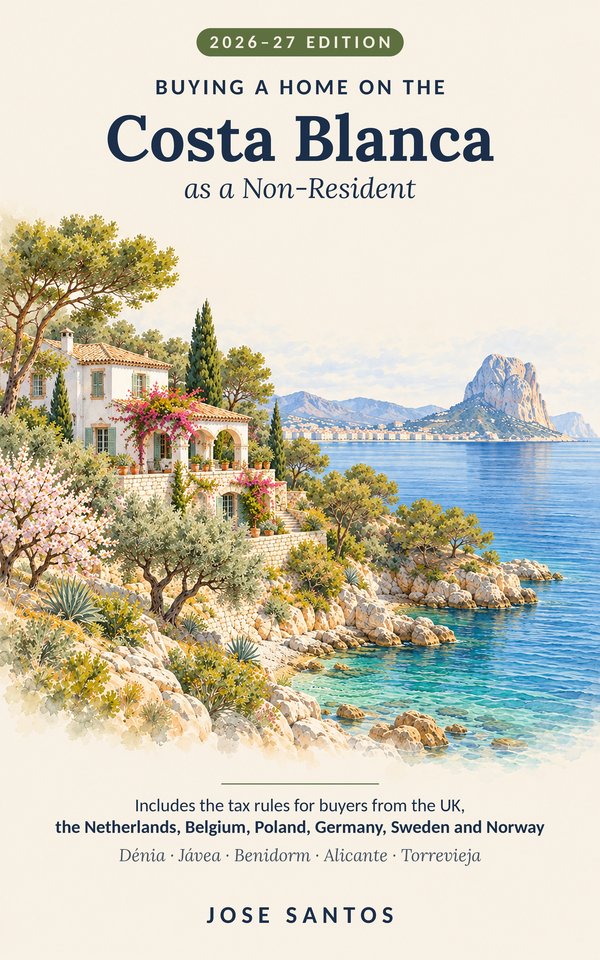
More detail in the book. Chapter 10 of Buying a Home on the Costa Blanca as a Non-Resident cover this with worked examples, deadlines and the risks behind the figures.
General information based on the rules in force in October 2026, not legal or tax advice. Rules change often: check your own case with an independent Spanish lawyer or tax adviser before you act.
Related: Inheritance tax on a Costa Blanca home when you live abroad · How much does it cost to buy a home on the Costa Blanca?