Modelo 210: the yearly tax return for non-residents
Form 210, the modelo 210, is the non-resident income tax return. If you own a home in Spain and do not live there, you file it every year, even if the home is never let, because Spain taxes a notional income on it. You also use it to declare rent if you let the home, and the gain when you sell. Each owner files their own return for their own share.
Tax on income you never received
If you do not let your Spanish home, Spain assumes it produces an income for you and taxes it. This is called renta imputada, or notional income, and it applies to every non-resident owner. The rules are national, so they are the same in the Balearic Islands and on the Costa Blanca:
- The notional income is 1.1% of the property's cadastral value if that value has been revised in the last ten years, or 2% if it has not.
- It is taxed at 19% if you live in the EU, Iceland, Norway or Liechtenstein, and at 24% if you live anywhere else, including the United Kingdom.
- If you let the home for part of the year, only the days it was not let count.
The cadastral value is not the price you paid. It is an administrative value, usually lower, that appears on your local property tax (IBI) bill, so keep those bills.
At the time of writing (October 2026), a Spanish housing decree of September 2026 that would have raised the notional income rate for many homes from 2027 has been rejected by Congress, so the rates above still apply.
Two examples from the books
Both books work through a home that is not let at any point in the year, owned by a Dutch owner (19%) and a British owner (24%):
| Example | Revised cadastral value | Notional income (1.1%) | Tax at 19% | Tax at 24% |
|---|---|---|---|---|
| Balearic home | €300,000 | €3,300 | €627 | €792 |
| Costa Blanca villa bought for €450,000 | €150,000 | €1,650 | €314 | €396 |
A couple who own the home jointly each file for their own half.
When to file
The deadlines have changed recently, which is why online guides disagree. At the time of writing:
- Notional income: income for 2025 can be declared at any time during 2026. From 2026 income onwards, the window runs from 1 April to 31 December of the following year.
- Rental income: since Order HAC/623/2026 of June 2026, rent is declared once a year, between 1 and 20 April of the following year (1 to 15 April if you pay by direct debit). Income earned in 2026 is therefore declared in April 2027.
2026 is a transition year for rent. If you declare each letting separately instead of grouping the year, income from January to September 2026 keeps the old quarterly deadlines (the first 20 days of April, July and October 2026), and only income from October to December moves to April 2027.
If you let the home
Rental income is taxed in Spain whatever your country of residence, on form 210. Residents of the EU, Iceland, Norway and Liechtenstein pay 19% and can deduct IBI, community fees, insurance, repairs, mortgage interest and depreciation, in proportion to the days the home was let. Everyone else, including UK residents, pays 24% on the gross rent with no deductions. For the days you use the home yourself or leave it empty, the notional income tax still applies.
| Book example | EU/EEA owner (19% on net) | Other owner (24% on gross) |
|---|---|---|
| Balearics: €40,000 of rent, €16,000 of expenses | €4,560 | €9,600 |
| Costa Blanca: €20,000 of rent, €8,000 of expenses | €2,280 | €4,800 |
Whether you can let to tourists at all depends on regional rules, which are very different in the two regions. Your own country may also tax the same income.
When you sell
Form 210 is also the return for the gain on a sale, taxed at 19% wherever you live. You file it roughly four months after signing, and use it to reclaim any excess of the 3% your buyer withheld. See the 3% withholding and how to get it back.
Who files it, and do you need a tax representative?
You can file yourself, but many owners use a gestoría or tax adviser, who files form 210 each year, receives tax notices in Spanish and can act as your representative. Appointing a tax representative is not compulsory for everyone:
- If you live in an EU country, or in Iceland, Norway or Liechtenstein, you do not have to.
- If you live elsewhere, for example the UK, Switzerland or the US, only in specific cases, including when the tax agency requires it because of your income or property in Spain.
- If you live in a jurisdiction Spain classes as non-cooperative, you must if you own assets in Spain.
Failing to appoint one when required carries a €2,000 fine, or €6,000 in a non-cooperative jurisdiction. The regional guides explain the full yearly bill for owners in the Balearics and the Costa Blanca, including IBI and wealth tax. For your own situation, ask a Spanish tax adviser.
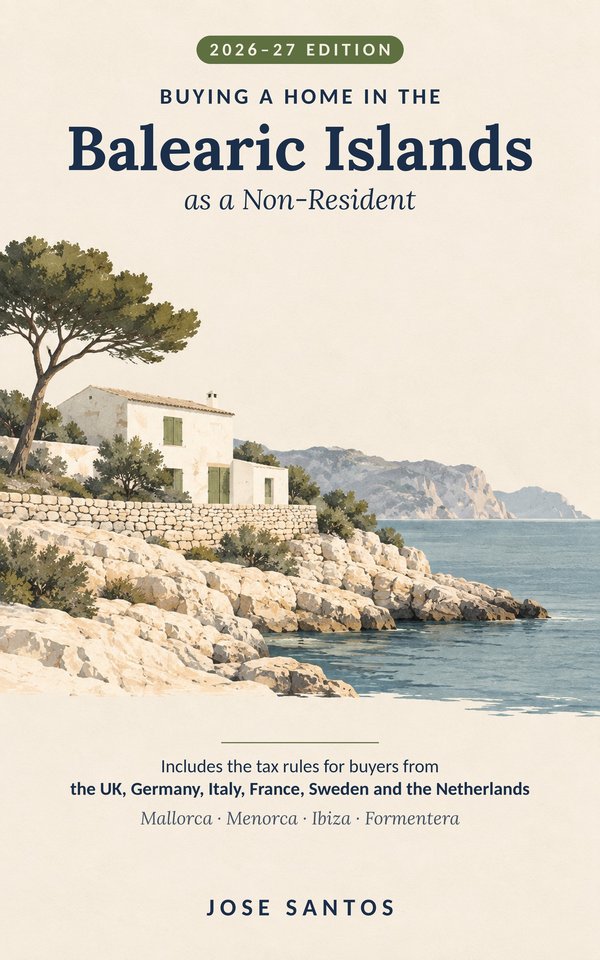
More detail in the book. Chapters 8 and 9 of Buying a Home in the Balearic Islands as a Non-Resident cover this with worked examples, deadlines and the risks behind the figures.

More detail in the book. Chapters 8 and 9 of Buying a Home on the Costa Blanca as a Non-Resident cover this with worked examples, deadlines and the risks behind the figures.
General information based on the rules in force in October 2026, not legal or tax advice. Rules change often: check your own case with an independent Spanish lawyer or tax adviser before you act.
Related: How much does it cost to buy a home in the Balearic Islands? · How much does it cost to buy a home on the Costa Blanca?