How does buying a house in Spain work? Step by step
Buying a home in Spain follows a set order: offer, reservation, legal checks, a private contract with a deposit, the mortgage if you need one, signing the deed before a notary, and then taxes and registration. Several weeks to a few months between offer and completion is common. The costliest mistakes happen when buyers sign or pay before the checks are done.
The route from offer to keys
| Step | What happens | Who is involved |
|---|---|---|
| 1. Offer | You agree a price with the seller, usually through an agent | You, agent, seller |
| 2. Reservation | A small deposit takes the property off the market while your lawyer checks it | You, agent |
| 3. Legal checks | Your lawyer checks ownership, charges, licences and planning | Your lawyer |
| 4. Private contract (arras) | You sign a private purchase contract and pay a larger deposit | You, seller, both lawyers |
| 5. Mortgage, if any | The bank values the home and issues its binding offer | You, bank, valuer |
| 6. Completion | You sign the deed before a notary, pay the balance and receive the keys | You, seller, notary, bank |
| 7. After completion | Taxes are paid, the deed is registered and utilities change hands | Your lawyer or gestoría |
How long it takes depends mostly on the legal checks, the mortgage and, for some non-EU buyers of rural land, a military permit.
Steps 1 and 2: the offer and the reservation
Once your offer is accepted, the agent will usually ask you to sign a reservation document and pay a small deposit. Check that it says three things:
- The deposit is refundable if your lawyer's checks reveal a problem.
- Who holds the deposit, and into which account it is paid.
- How long the reservation lasts before the private contract must be signed.
Keep the deposit small. The agent's commission is normally paid by the seller, so make sure the reservation document does not pass any of it to you.
Step 3: the legal checks
Your lawyer should check everything before you sign the private contract and pay the main deposit. That includes a nota simple from the Land Registry, which shows the registered owner and every charge on the property, and a comparison with the Catastro record and with what is actually on site. Your lawyer should also ask for the licences and certificates, and for proof that local property tax (IBI) and community fees are paid up. Country houses on rural land need extra care; our guide for foreign buyers explains the military permit.
Step 4: the private contract and the deposit
The private purchase contract, often called a contrato de arras, fixes the price, the completion date and what happens if either side pulls out. It is usually signed after the checks, with a deposit that in practice is often around 10% of the price, although the amount is freely agreed. The type of deposit matters:
| Type | If the buyer walks away | If the seller walks away |
|---|---|---|
| Penitential (arras penitenciales, article 1454 of the Civil Code) | The buyer loses the deposit | The seller must return the deposit twice over |
| Confirmatory (arras confirmatorias) | The deposit counts as part-payment; the seller can go to court to force the sale or claim damages | The buyer can go to court to force the sale or claim damages |
Make sure the contract states which kind you are signing. Your lawyer can also make it conditional on events you do not control: the mortgage being approved, a military permit being granted, the seller legalising an unlicensed structure or cancelling a mortgage, and, if the seller is non-resident, the 3% withholding and the estimated municipal gains tax being kept back from the price. On the Costa Blanca, it can also require the seller to pay any outstanding urban development charge first.
Step 5: the mortgage
If you are borrowing, the bank values the home and issues its binding offer. It must give you the standard European information sheet (FEIN), and at least ten calendar days must pass between receiving the documents and signing. During that time you visit the notary, who explains the terms free of charge.
Step 6: completion at the notary
You and the seller, or your representatives with powers of attorney, sign the public deed (escritura) before a notary. The notary checks identities, powers and the Land Registry. The balance is paid, usually by banker's draft or bank transfer, and recorded in the deed. If the seller is non-resident, 3% of the price is kept back. If you do not speak Spanish, the notary must be satisfied that you understand the deed, so ask your lawyer to arrange an interpreter or a deed in both languages.
Ask your lawyer for a completion statement beforehand showing every amount.
Step 7: after completion
- Transfer tax or stamp duty is paid on form 600 within one month, to the Balearic tax agency (ATIB) or the Valencian tax agency (ATV).
- If the seller is non-resident, you pay the 3% withholding on form 211 within one month, and the municipal gains tax (plusvalía municipal) within 30 working days, normally from the amount you held back.
- The deed is registered in your name at the Land Registry.
- Electricity, water, IBI and community fees are changed into your name and set up for direct debit.
For what the taxes and fees add up to, see the cost guides for the Balearic Islands and the Costa Blanca, or try the free calculators for the Balearics and the Costa Blanca. Before you start, read how to choose an independent lawyer.
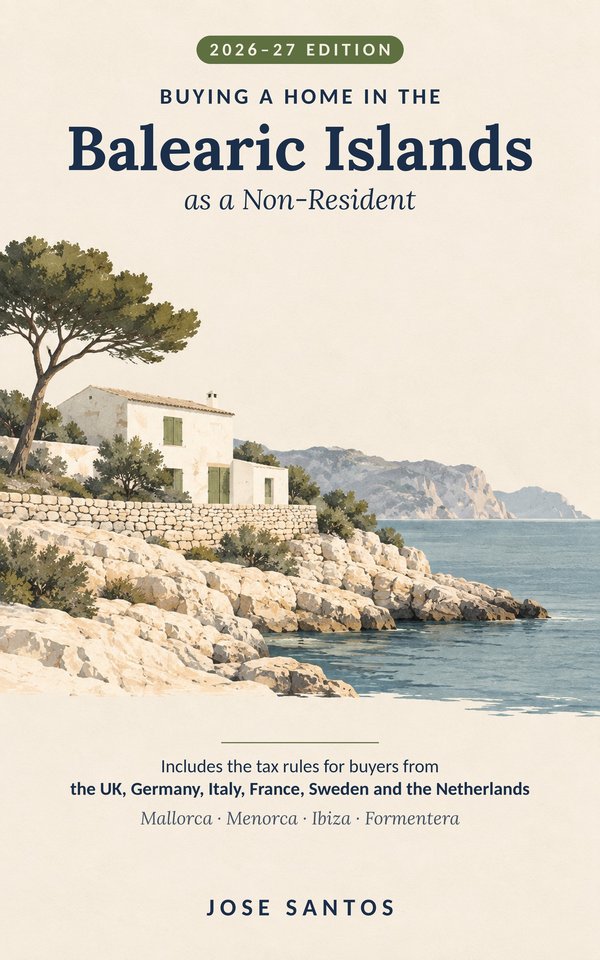
More detail in the book. Chapter 3 of Buying a Home in the Balearic Islands as a Non-Resident cover this with worked examples, deadlines and the risks behind the figures.

More detail in the book. Chapter 3 of Buying a Home on the Costa Blanca as a Non-Resident cover this with worked examples, deadlines and the risks behind the figures.
General information based on the rules in force in October 2026, not legal or tax advice. Rules change often: check your own case with an independent Spanish lawyer or tax adviser before you act.
Related: How much does it cost to buy a home in the Balearic Islands? · How much does it cost to buy a home on the Costa Blanca?